
Growing its subscription revenue +70%: L'Équipe's winning bet



When the mobile app became a growth engine
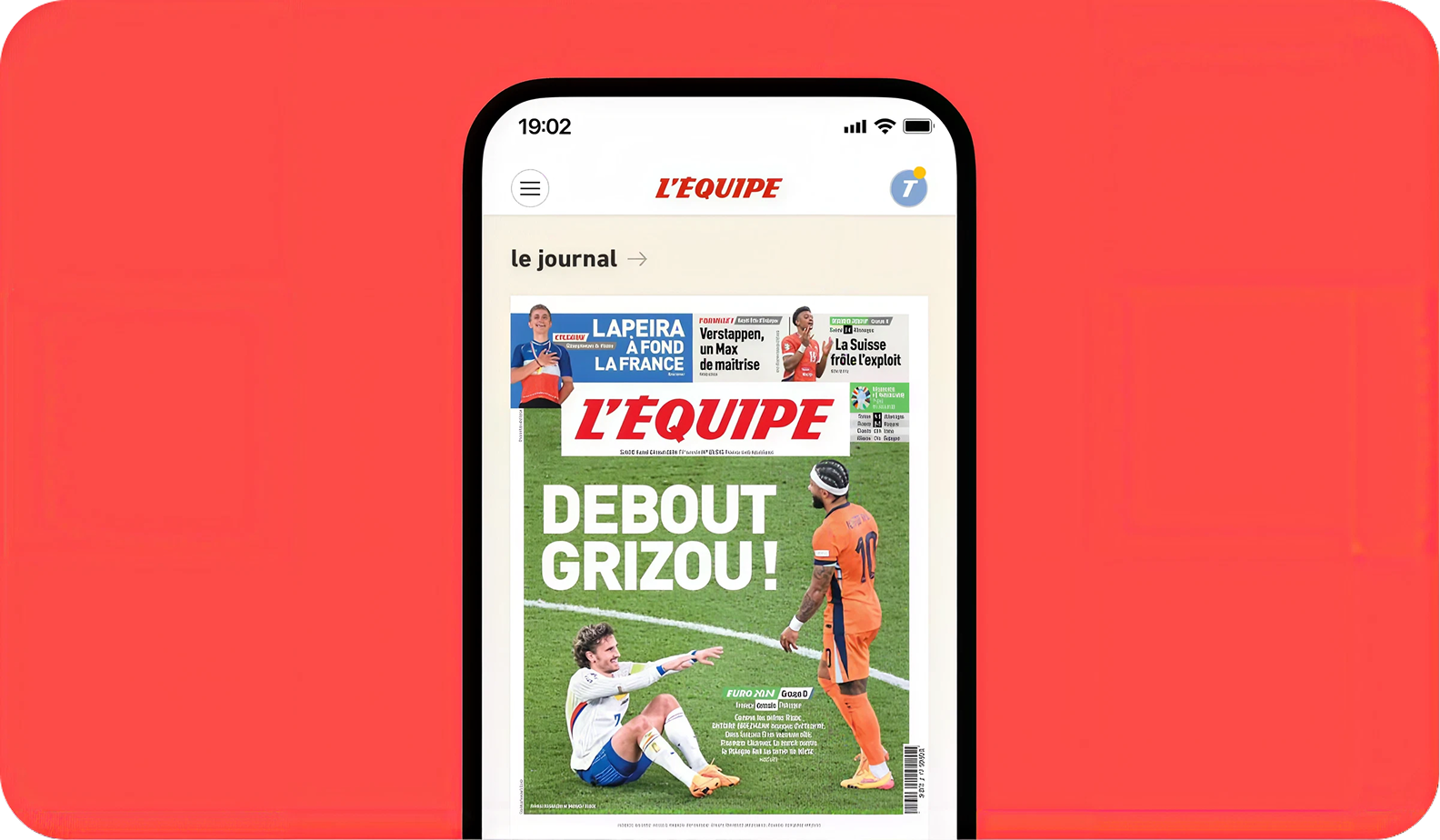
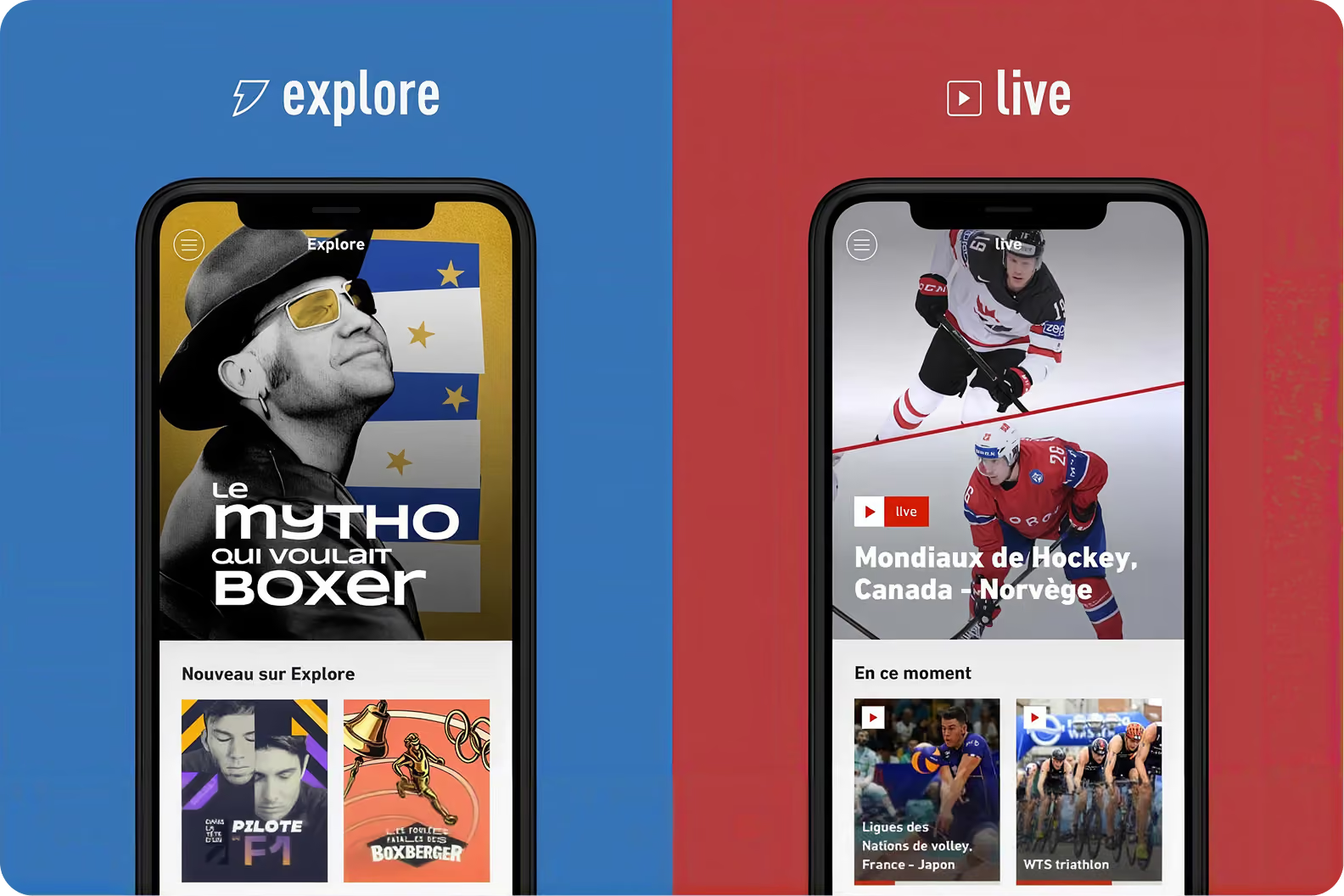
For decades, L'Équipe built one of France's strongest media brands around a simple promise: bring sports fans closer to the stories, competitions and athletes they care about. What started as a daily newspaper in 1946 gradually expanded into magazines, a website launched in 2000, and eventually a mobile app designed for a new generation of +300K readers.
Today, more than 300 journalists produce content that reaches audiences across print, web and mobile. Yet, while these channels share the same editorial mission, they no longer play the same strategic role.
When Rolf Heinz became CEO in 2024, he introduced Vision 2030, an ambitious roadmap aiming to reach 20 million monthly unique visitors and 500,000 digital subscribers. Growing the web business alone would not be enough to get there, and mobile had become too important to remain simply another distribution channel. It had to become a growth engine in its own right.
That shift was already visible in user behavior. By early 2025, the company's most engaged readers increasingly logged into L'Équipe's mobile app, where login was quickly forced by the UX - a voluntary strategy as L’Équipe wished to better know its customer.
That strategy was key to detect signals through their account use, then turn them into an onboarding narrative that led to subscription offers.
Unlike casual visitors arriving from search engines or social media, app users opened L'Équipe repeatedly throughout the week, followed their favorite teams through personalized notifications and consumed significantly more content every session.
"The app is no longer an extension of the website," says Fabien Mulot, Head of Customer Marketing at L'Équipe. "It's a digital product in its own right. Editorial content remains at the heart of what we do, but user experience, personalization and subscriptions have become just as important in the relationship we build with our readers."
For L'Équipe, this fundamentally changed the challenge. The question was no longer how to bring readers to mobile as they were already there. Instead, the challenge was to turn this highly engaged audience into long-term subscribers without compromising the experience that kept them coming back.
The users are already there. So why isn't subscription growth following?
The real bottleneck
The more L'Équipe invested in its mobile app, the clearer the opportunity became.
Between 2023 and 2024, the company made account creation mandatory within the app, dramatically increasing the number of logged-in users. That decision transformed mobile into one of L'Équipe's richest sources of first-party data. More than 90% of app users were now signed in, and internal data showed that someone with an account was eighteen times more likely to become a subscriber than an anonymous visitor.
The opportunity was obvious, the results less so. While subscriptions on the web kept growing steadily, mobile wasn't following the same trajectory. L'Équipe had successfully built a large audience of highly engaged users, but it wasn't converting that engagement into subscription growth at the pace the business needed.
Every meaningful change to the app - from a paywall variation to a different subscription page or a new onboarding flow - required engineering resources, product prioritization and data support. Even running a single A/B test meant securing a place on the development roadmap, waiting for a release cycle, then relying on other teams to extract and interpret the results.
"We weren't short of ideas," recalls Fabien Mulot. "We were short of opportunities to test them."
Unlike the web, where experimentation was relatively accessible, the mobile app remained constrained by technical dependencies. Over two years, the team launched only a handful of experiments, often under conditions that made the results difficult to interpret. Each new subscription offer created additional scenarios to test, yet every new hypothesis encountered the same operational bottleneck.
"We arrived at Purchasely with a huge shopping list of everything we hadn't been able to test for two years," says Mulot.
L'Équipe was looking for a faster way to learn from their ideas.
→ How do you remove an operational bottleneck without recruiting?
Buying speed
When L'Équipe started evaluating new solutions in early 2025, the team already had a clear vision of where it wanted to go, but it lacked the ability to get there fast enough.
Every new subscription bundle, every personalized offer and every conversion hypothesis added another experiment to the roadmap, while the process for validating those ideas remained largely unchanged.
In short, the challenge had become structural, and the team was looking for a way to remove the operational friction standing between an idea and its implementation.
Purchasely stood out because it shifted ownership of in-app experimentation back to the people designing the customer journey. Instead of relying on engineering resources for every iteration, marketing teams could build, launch and measure subscription experiences themselves. Paywalls, onboarding screens, pricing pages and promotional campaigns could all evolve continuously rather than waiting for the next product release.
That autonomy especially mattered since L'Équipe wished to expand its subscription strategy. Alongside its traditional digital subscription, the company introduced new bundled offers combining L'Équipe with services such as Ligue 1+ and Eurosport, meaning a single subscription page was no longer enough.
Different audiences required different messages, different entry points and different value propositions depending on where they encountered the offer. Those questions could not be answered through intuition alone, they required experimentation at a pace the previous workflow simply couldn't sustain.
Purchasely drastically changed how quickly the L’Équipe team could discover what actually worked. That shift would become visible almost immediately, through something quite simpler: the ability to experiment without waiting.
L'Équipe also weighed that decision against a wider market: Purchasely wasn't the only option, and plenty of teams try to solve in-app experimentation by building tools in-house.
What tipped the balance was, in part, peer validation, as several other well-known media brands were already working with Purchasely and spoke positively of the experience. Purchasely was also one of the few vendors specialized specifically in app subscription funnel optimization, rather than paywall-optimization only.
Its annual fixed-price model made it easy for L'Équipe to control costs and forecast ROI from the start.
Building an internal tool, or contracting external engineering resources to do so, would have meant compromising on quality and reliability, and simply didn't make sense from a business economics perspective.
Purchasely stepped in exactly where L'Équipe's existing tools stopped.
→ "Why did this major media company decide this was the right solution?"

A fast integration is only the beginning
For a platform designed to accelerate experimentation, the implementation itself couldn't become another lengthy project. It didn't.
L'Équipe integrated Purchasely in roughly three weeks, over two development sprints. The work was spread across existing priorities rather than treated as a standalone initiative, with only a small portion of the team's time dedicated to the rollout. From a technical standpoint, the integration remained deliberately lightweight: adding Purchasely meant integrating a single SDK into the existing application.
"The integration wasn't particularly complex," says Fabien Mulot. "At the end of the day, it was just an SDK to add to the app."
Throughout the rollout, Purchasely also assigned forward-deployed engineers to support the integration and testing of the SDK directly with L'Équipe's teams, making sure it was done right the first time and keeping back-and-forth on critical questions to a minimum.
Just as importantly, L'Équipe didn't have to change anything about how it already managed its subscriptions. Like many media companies, which sell subscriptions in-app, on the web and in print, typically all managed through a single system, L'Équipe could optimize and experiment on its in-app subscription funnels without overhauling its existing subscription infrastructure, a process that is usually lengthy and risky.
What made the difference wasn't only the technical simplicity, but the way the project was supported. Throughout the implementation, Purchasely worked closely with L'Équipe's product and marketing teams to help configure the platform, challenge early use cases and ensure the first experiments could be launched quickly.
Many platforms are successfully installed without ever becoming part of a company's daily workflow. L'Équipe wanted the opposite as its objective was to give marketing teams the confidence to use it independently from day one. As soon as the contract was signed, that confidence started translating into action. The backlog of ideas that had accumulated over two years was no longer waiting for engineering bandwidth. It was finally ready to be tested.
→ Okay... so what did they actually do once they had all that freedom?
Experimentation as a philosophy
Experimentation became the way L’Équipe fine-tuned its subscription business as the first experiments were about answering questions the team had been carrying around for months:
How should a subscription offer be presented to someone reading a match report rather than a transfer article? Should a football fan see the same proposition as a tennis enthusiast? Would an inline paywall, embedded directly within an article, outperform the traditional full-screen subscription page? How should new bundles such as L'Équipe + Ligue 1+ or L'Équipe + Eurosport be promoted depending on what readers were actually consuming?
For the first time, those questions could be answered, fast, with experiments instead of assumptions. One of the earliest successes came from redesigning the subscription journey itself. Rather than systematically redirecting readers to a dedicated subscription page, L'Équipe began testing inline paywalls inserted directly into editorial content. Removing that additional step significantly reduced friction. In some scenarios, conversion rates increased by nearly 45%, validating a much simpler purchasing experience than the team had originally imagined.
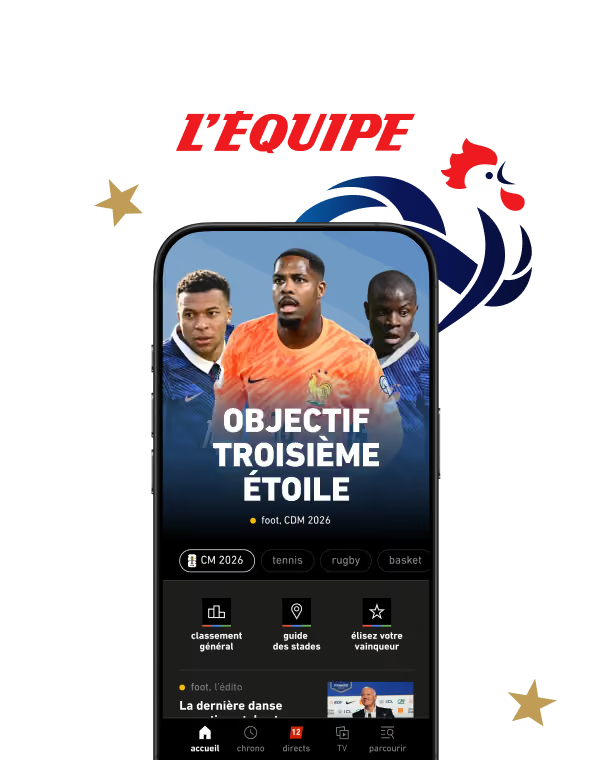
The team quickly realised that the experiment was more about signals and context than about paywalls. And so L’Équipe subscription journeys became increasingly adaptive: messaging could evolve depending on the content being read, the user's profile or the current sporting calendar. During major events such as the FIFA World Cup, for example, subscription screens adopted dedicated visuals and messaging that reflected the atmosphere of the competition instead of relying on generic campaigns. Seasonal promotions, anniversary campaigns and league-specific offers could all be launched without waiting for a new app release.
Experimentation soon extended beyond acquisition. Onboarding became another area of focus. The team introduced personalized onboarding flows that encouraged new subscribers to select their favorite sports, competitions and teams from their very first session. Those preferences immediately shaped notifications, recommendations and content discovery, helping users find value faster.
Even an initial layer of personalization reduced early churn by several percentage points, encouraging L'Équipe to invest even further in onboarding the following year.
Retention followed the same logic. Instead of treating cancellation as the end of the customer journey, L'Équipe started redesigning cancellation flows to better understand why subscribers were leaving and intervene while there was still time to retain them.
Looking back, what began as a project to fix acquisition and conversion expanded, within months, to cover the entire subscription funnel. Marketing first turned to Purchasely to convert more readers; it wasn't necessarily expecting to also gain the tools to address what happens before conversion, through onboarding, and after it, through retention.
That's a pattern Purchasely sees often: customers set out to fix one leak in the funnel, and end up equipped to address it holistically, moving from being unable to act on most of the funnel to comprehensively addressing every stage of subscription growth.
Richer subscription data also opened the door to more reliable CRM automation and more relevant win-back strategies as the company continued connecting Purchasely with the rest of its marketing stack.
Perhaps the most unexpected change happened behind the scenes, as experimentation itself became measurable. Previously, evaluating an A/B test often meant asking the data team to build custom reports before marketing could determine whether an experiment had worked. Purchasely's dashboards gave the team direct visibility into subscription and revenue performance, allowing marketers to analyse results independently while having more informed conversations with product and data teams.
"It creates a virtuous circle," says Fabien Mulot. "We have a much better understanding of what's happening in the app, and that makes every conversation with our data team more valuable."
That measurability became a discipline of its own. Each month, the team reviewed subscriber and revenue trends alongside the results of every live experiment directly in their Purchasely dashboards, often blended with L'Équipe's own BI tools, turning what used to be a data-team request into an ongoing, self-serve routine.
Real-time visibility into conversion and revenue meant a test's outcome no longer took days to extract and interpret, and every experiment closed with a clear, data-backed next step rather than a guess.
- Onboarding: Fabien Mulot could see the revenue impact of a personalized onboarding A/B test directly in the dashboard, something that previously required a formal request to the data team.
- Paywalls: before Purchasely, new paywall designs on mobile typically followed what had already been proven on the website — like many publishers, L'Équipe tended to validate an offer structure on web first, and the app came second, adapting those learnings once they'd already been de-risked elsewhere.
That dynamic has almost reversed. Every inline paywall test, on articles and video alike, is now tracked through conversion and revenue dashboards directly in the app, letting the team compare variants and decide within weeks, days, even hours, whether to extend a winning design — with the website now the one catching up.
When a mobile app's inline paywall redesign drove a sharp jump in article conversion, it was then replicated back onto the website, rather than the reverse.
- Payment experience: A/B tests on Android's payment flow (upfront vs. monthly installments) were measured on subscription volume and mix, giving the team the data to give the greenlight to extend the winning version to iOS.
Within a few months, the backlog that had accumulated over two years had largely disappeared and experimentation had become part of how L'Équipe made product decisions every day.
From dependencies to ownership
Before Purchasely, experimentation was a cross-functional effort. Marketing could identify opportunities, but bringing them to life required coordination with product, engineering and data teams at almost every step. Launching a simple A/B test meant securing development time, waiting for a release cycle, requesting data extractions and aligning multiple stakeholders before a decision could finally be made.
As Purchasely became part of L'Équipe's workflow, those responsibilities gradually shifted. Marketing no longer had to wait for engineering capacity to test a new subscription journey or refine a paywall. Product teams could stay focused on building the app itself, while data specialists spent less time producing ad hoc reports and more time helping interpret broader behavioural trends. Rather than creating new silos, the platform allowed each team to concentrate on the work where it brought the most value.
That shift is perhaps best illustrated by Maryne, who joined L'Équipe as the company was rolling out Purchasely. Instead of acting as a project coordinator between departments, she quickly became the person driving experimentation across the app. Launching a new A/B test, updating the wording of a call-to-action or adapting a subscription flow to a specific campaign became part of her day-to-day work, without depending on the next product release.
"What used to take at least two weeks can now take about an hour," says Fabien Mulot. "Marketing is autonomous on these topics from end to end. We can launch a test, monitor its performance and decide what to do next ourselves."
That autonomy also changed conversations across the business. Instead of approaching the data team with requests for one-off analyses, marketers arrived with concrete observations already backed by Purchasely's dashboards. Discussions became less about collecting data and more about understanding user behavior and identifying the next opportunity to improve the subscription experience. As experimentation accelerated, shared knowledge grew with it.
In many companies, experimentation remains something teams do when they have enough time. At L'Équipe, it became part of how the company operates. The impact of that cultural shift soon became visible far beyond the experimentation roadmap.
When experimentation compounds
The impact of Purchasely came from compounding improvements. Every optimization removed a little friction from the subscription journey. Every A/B test replaced an assumption with evidence. Every dashboard made the next decision easier than the previous one. Over time, those incremental gains translated into measurable business outcomes.
The first signs appeared almost immediately. L'Équipe's initial A/B tests delivered a 36% uplift in conversion, validating a new approach to subscription journeys while giving the team confidence to keep experimenting. Rather than treating those results as an isolated success, they became the starting point for a continuous optimisation process.
As experimentation expanded across acquisition, onboarding and retention, the impact became visible at a much larger scale. Inline paywalls alone increased conversion rates by up to 50% year over year in some scenarios by removing unnecessary friction from the purchasing journey. Meanwhile, the growing ability to personalize offers, adapt campaigns to major sporting events and optimize subscription experiences for different audiences contributed to a 50% increase in L'Équipe's subscription base and a 70% increase in subscription revenue in 9 months.
Those numbers tell only part of the story. For Fabien Mulot, one of the biggest changes was the team's ability to prove business impact as it happened. Marketing initiatives were no longer evaluated through isolated performance indicators or delayed reporting. Each experiment could be directly linked to subscription and revenue outcomes, making it easier to prioritize ideas, secure internal alignment and justify future investments.
That visibility also changed the economics of experimentation. "The platform has largely paid for itself," explains Nicolas Tissier, Purchasely’s Co-founder and CPO. "When you compare the additional subscription revenue generated every month with the investment required to run Purchasely, the return is obvious." The recurring subscription business grew by roughly 60% in monthly recurring revenue, illustrating how operational agility can ultimately translate into financial performance.
Because Purchasely runs on a fixed-price licensing model, that growth compounds directly into return: as subscription revenue keeps climbing, the cost of running the platform stays flat, so ROI grows exponentially rather than linearly. Put simply, the incremental subscription revenue generated represents more than 70 times the cost of the platform, an ROI above 7,000%.
Looking back, it's tempting to describe Purchasely as an experimentation or a paywall tool. It actually gave L’Équipe a faster way to learn, when the ability to learn faster than your competitors may be the most durable advantage of all.
Never stop testing
When L'Équipe set out to improve its mobile subscription business, it wasn't looking for more ideas. It already had them. What it needed was the ability to turn those ideas into experiments, and those experiments into decisions.
That's ultimately what changed. Purchasely didn't redefine L'Équipe's subscription strategy. It gave the team the freedom to execute it. Faster experimentation led to better user journeys. Better user journeys led to higher conversion and stronger subscription revenue. Just as importantly, marketing teams became active drivers of product optimisation instead of waiting for development cycles.
For subscription businesses, that's perhaps the most valuable lesson. Competitive advantage rarely comes from finding the perfect paywall, onboarding flow or pricing page on the first attempt. It comes from building an organization that can continuously test, learn and improve.
Because in the end, the companies that grow the fastest aren't always those with the best ideas. They're the ones that learn the fastest.
Key takeaways
- Mobile had already become a major subscription channel for L'Équipe. The challenge was no longer acquisition, but maximizing the value of an already engaged audience.
- By removing technical dependencies, Purchasely enabled marketing teams to experiment independently and dramatically increased the pace of iteration.
- Continuous experimentation across paywalls, onboarding, personalization and retention generated measurable gains in conversion, subscription revenue and operational efficiency.
- Beyond successful business metrics, the biggest transformation was organizational: experimentation became part of L'Équipe's everyday workflow rather than an occasional product initiative.
- When mobile becomes a strategic revenue channel, the companies that win aren't necessarily the ones with the best ideas. They're the ones that can test, learn and iterate the fastest.
Key numbers
- +36% Conversion uplift
- +50% Inline paywall conversion
- +50% Subscription base
- +70% Subscription revenue
- +60% MRR growth
+9 months after installing Purchasely.
About company
Start getting results with Purchasely
Keep reading

Enhancing User Experience through Personalization
This case study explores how app personalization can significantly improve user engagement.
Increasing MRR by 85% against free competitors: TomTom's experiment-led playbook
TomTom GO Navigation grew MRR by 85% by replacing release-cycle-bound testing with Purchasely's no-code A/B testing platform, running 90+ experiments across onboarding, pricing, and retention in four quarters. Discover how the team turned experimentation into a growth engine against free, pre-installed competitors like Google Maps